
The psychosis risk team is consisted of many members, including Wang Jijun, Zhang Tianhong, Tang Yingying, Cui Huiru, Xu Lihua, Wei Yanyan, Hu Yegang, Tang Xiaochen and postgraduates. The team has completed many key projects in the early psychosis field, the national K&D projects funded by the Ministry of Science and Technology (2016YFC1306800), multiple projects funded by National Natural Science Foundation of China. The team has also participated multiple NIH/FNIH funded projects on prodromal psychosis (U01MH24639, R01 MH111448, R01MH112733, etc). More recently, the team was selected to participate as one of the acquisition sites of the NIH/FNIH funded Accelerated Medicines Partnership – Schizophrenia (AMP-SCZ) study, as part of the ProNet network. It has publications in JAMA Psychiatry, The American Journal of Psychiatry, Molecular Psychiatry, Nature of Mental Health, etc.
Early identification of psychosis is difficult because of lack of clinical operational identification standards. The team establishes the identification standard of clinical high risk syndrome of psychosis in China, and moves the clinical identification window from the first episode of psychosis to the clinical high risk period (ultra early stage), so as to achieve [risk identification]. The project collects and develops behavioral and multi-dimensional biomarkers of clinical high-risk syndrome, conducts regular follow-up, establishes ShangHai Psychosis At high Risk (SHARP) cohort, and keeps the construction standards consistent with the international standards. It has become the largest single center and the best homogeneous cohort in the world in this field. Its quality has been appreciated by Professor Cannon, one PI of North American Prodromal Psychosis Longitudinal Study (NAPLS) of Yale University. Based on SHARP cohort, the team found the characteristics of cognitive deficits of high-risk groups, developed a personalized psychiatric risk calculator (SHARP-RC), quantified risks and guided interventions.
The team reported New biomarkers for ultra early psychosis. Basing on "oxidative stress - cell membrane damage - reduced neural plasticity" hypothesis, the team explored biomarkers from the central and peripheral systems respectively. They reported that the volume integrity of hippocampus can quantify the early course of disease, the neurofibropathy of ultra early psychosis phase in the brain, the cortex limbic functional connection abnormality module of ultra early psychosis phase, etc. These pathological changes, being consistent with the lipid metabolism markers in the peripheral blood, and the nicotinic acid skin flushing reaction, deconstruct the risk of psychosis, and realize the risk nature analysis [attribution risk]. They establish the technology of psychosis risk early warning. Professor Kalin, editor-in-chief of The American Journal of Psychiatry, provided the comments that the neurofiber free water imaging technology will have an important impact on diagnosis and treatment of ultra early phase of psychosis.
The team explored Non-pharmacological intervention technology for early psychosis. Based on the characteristics of biological subtypes of psychosis risk, the project develops individualized and cause specific treatment methods, focuses on applying non-pharmacological interventions, such as neural modulation of transcranial magnetic stimulation (TMS), antioxidative supplement and cognitive behavioral therapy, and therefore it achieve [risk reduction]. It first report the rTMS over left inferior parietal lobe can decrease the psychosis risk among populations at clinical high risk of psychosis (Schizophrenia Bulletin 2023).
The team released "Expert Consensus on Clinical High Risk Syndrome of Psychosis in China" to promote the application of the mode in 2021. Professor Yu Xin, former chairman of Psychiatry Branch of Chinese Medical Association, said that this is "a landmark event in the development of psychiatry in China".
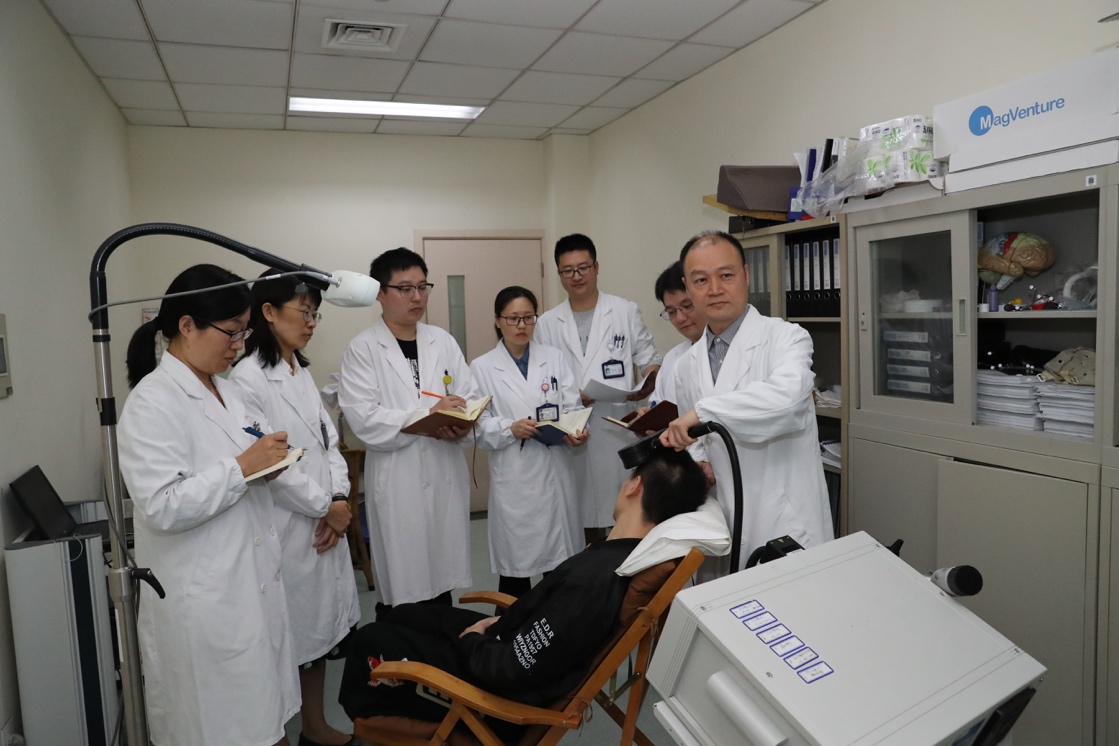
Fig. The team has exploring neuroimage guided repetitive transcranial magnetic stimulation
XUHUI CAMPUS:NO.600 WANPING NAN ROAD,SHANGHAI,PRC,200030
MINGHANG CAMPUS:NO.3210 HUMIN ROAD,SHANGHAI,PRC,201108
TEL:021-32100600FAX:021-32100600
Copyright © 2013-2021.Shanghai Mental Health Center 沪ICP备09022636号-3