1. Advanced Science 丨Astrocytic FDX1 Contributes to Copper Dyshomeostasis-associated Synaptic Dysfunction in Depression and Is Modulated by Exercise
In June 2026, a research team led by Lan Yan from the Shanghai Mental Health Center collaborated to publish an online paper in Advanced Science titled "Astrocytic FDX1 Contributes to Copper Dyshomeostasis-associated Synaptic Dysfunction in Depression and Is Modulated by Exercise". Combining clinical sample data and mouse models, this study investigated the role of disrupted copper homeostasis in depression.
Mounting evidence has established a correlation between major depressive disorder (MDD) and impaired astrocyte function; nevertheless, the mechanistic cascade whereby peripheral metabolic abnormalities trigger glial pathological changes has not been fully elucidated. Perturbations in trace metal homeostasis, with copper dysregulation being a prominent candidate pathogenic factor, have attracted growing research attention, whereas the precise cellular cascades underpinning this pathological process are still largely uncharacterized. Yan et al. have combined clinical cohort samples with murine stress models to dissect the pathogenic function of disrupted copper balance in the pathogenesis of depression.
Corresponding experimental data verified elevated copper concentrations in the peripheral blood circulation of MDD patients as well as within the prelimbic cortex (PrL) region of chronically stressed mice. In rodent models, copper overload is accompanied by upregulated astrocytic ferredoxin 1 (FDX1) abundance, alongside a series of adverse phenotypes including decreased astrocyte density, simplified astrocytic morphological arborization, defective astrocyte calcium signal transduction, and aberrant excitatory synaptic transmission. Through astrocyte-targeted genetic intervention, in vivo calcium imaging monitoring and electrophysiological recording assays, Yan’s team validated that astrocytic FDX1 acts as a critical molecular mediator linking copper metabolic disorder to the malfunction of local neural circuits.
Intriguingly, aerobic physical exercise is capable of rectifying systemic copper homeostasis, reversing the abnormal overexpression of astrocytic FDX1, repairing disrupted astrocyte-neuron functional coupling, and ultimately ameliorating depression-associated behavioral phenotypes in animals. Collectively, the research by Yan et al. uncovers a novel astrocyte-dependent signaling axis that explains how peripheral copper dyshomeostasis reshapes central neural activity, meanwhile offering mechanistic explanations for the antidepressant efficacy of physical exercise against depression-induced neural impairments.
2. Advanced Science 丨A new study illuminates the neuromodulator dynamics that drive associative learning within the olfactory tubercle
Shuaishuai Hu and collaborators published "Neuromodulator Dynamics Underlying Associative Learning in the Olfactory Tubercle of the Ventral Striatum" in Advanced Science on March 23, 2026.
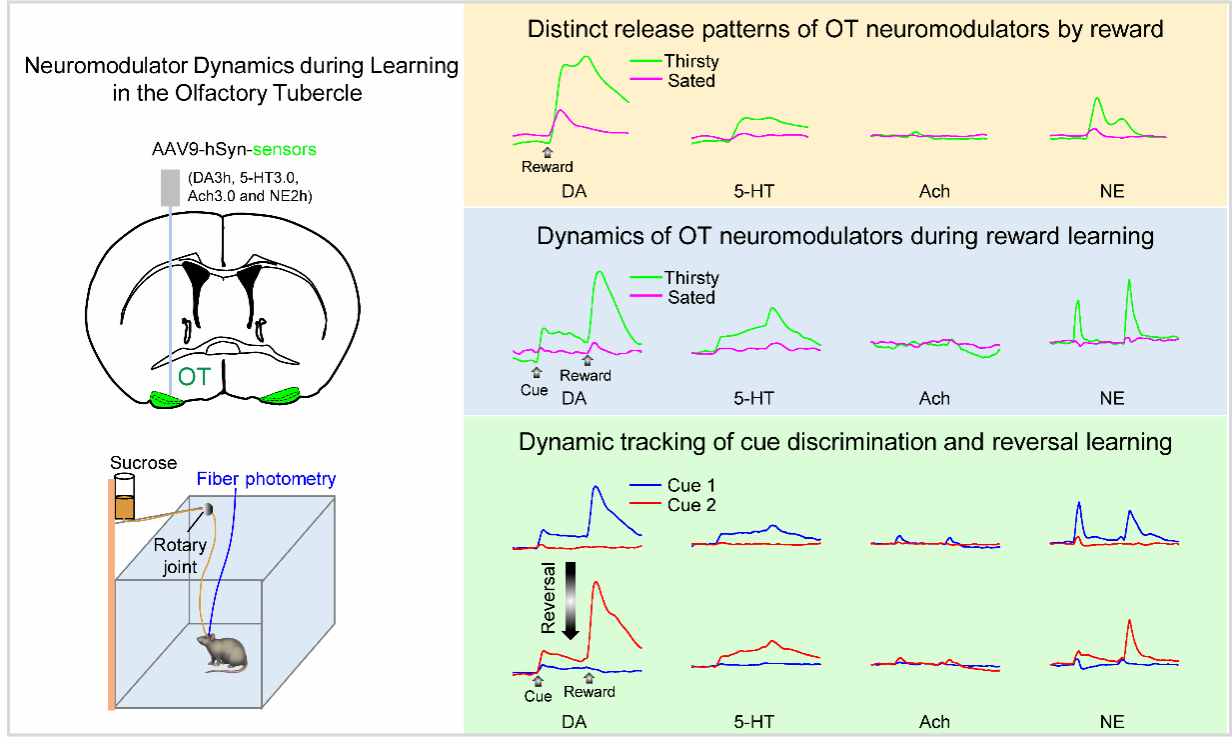
The brain’s neuromodulatory systems—particularly dopamine (DA), serotonin (5-HT), acetylcholine (ACh), and norepinephrine (NE)—play a crucial role in reward processing and associative learning. The olfactory tubercle (OT), a region that overlaps with the olfactory cortex and ventral striatum, has been implicated in non-olfactory functions such as learning and motivation. Moreover, it receives dense innervation from multiple neuromodulator-producing brain regions. Yet, how neuromodulator dynamics in the OT encodes external rewards and shapes different forms of associative learning remains unclear. Using fiber photometry and genetically encoded sensors, we captured reward-evoked release patterns of four neuromodulators in the OT and tracked their dynamics across distinct learning processes. We uncover sex-specific, state-dependent, and type-selective response dynamics to external rewards. Moreover, OT neuromodulators encode reward learning and extinction in a sexually dimorphic and state-dependent manner. Notably, unlike the nucleus accumbens (NAc), OT dopamine does not encode reward prediction error. Finally, these neuromodulators dynamically track cue discrimination and reversal learning. Together, we present a systematic framework mapping how OT neuromodulation encodes reward processing and associative learning. This advances our understanding of OT's roles in both healthy cognition and neuropsychiatric disorders, such as addiction and depression.
3. Psychological Medicine | Characterizing executive dysfunctions in patients with schizo-obsessive comorbidity: comparing schizophrenia with obsessive-compulsive disorder
In April 2026, Assistant Researcher Minyi Chu from the Shanghai Mental Health Center collaborated with investigators from the University of Hong Kong, Shanghai University, and the Institute of Psychology, Chinese Academy of Sciences to publish a new study inPsychological Medicine. The full article, entitled “Characterizing executive dysfunctions in patients with schizo-obsessive comorbidity: comparing schizophrenia with obsessive-compulsive disorder”, reveals novel insights into executive function alterations in psychiatric comorbidity.
Integrating traditional neuropsychological assessments with machine learning techniques, this study systematically delineates distinct executive dysfunction profiles across three clinical groups: individuals with schizo-obsessive comorbidity (SOC), standalone schizophrenia (SCZ), and standalone obsessive-compulsive disorder (OCD). The results offer essential cognitive evidence for unpacking the pathological mechanisms, improving clinical recognition, and advancing precision intervention for complex psychiatric comorbidities.
A total of 234 participants were recruited for the study, comprising 37 individuals with SOC, 68 with SCZ, 70 with OCD, and 59 healthy controls. Grounded on the SAS theoretical model of executive function, the research team decomposed executive function into six core domains, including task initiation and sustained attention. Comprehensive cognitive evaluations were conducted using standardized paradigms such as the Hayling Sentence Completion Test. To further identify group-specific cognitive signatures, the study adopted two robust machine learning algorithms, namely the Support Vector Machine (SVM) and Gradient Boosting Decision Tree (GBDT), to characterize high-dimensional executive function patterns across clinical populations.
Behavioral analyses indicated that executive function impairments were present in all three patient groups, yet each group exhibited unique deficit patterns. In particular, both SCZ and SOC patients showed additional impairments in sustained attention and planning capacity, yielding distinguishable cognitive signatures across diagnostic groups. Importantly, planning ability emerged as the most specific cognitive marker for SOC. This dimension not only differentiates SOC patients from healthy controls but also distinguishes SOC from pure SCZ and OCD, thereby substantiating the “dual-risk” hypothesis for SOC psychopathology.
Moreover, SOC patients demonstrated highly similar cognitive profiles to those with SCZ, suggesting that the executive dysfunction phenotype of SOC is predominantly convergent with the schizophrenia spectrum phenotype.
To our knowledge, this is the first study to systematically profile executive function deficits in SOC within a unified analytical framework. Moving beyond conventional pairwise group comparisons, the application of machine learning enables the identification of discrete cognitive biomarkers for SOC. Collectively, the findings demonstrate a unique cognitive impairment pattern in SOC characterized by shared deficits across disorders plus disease-specific alterations, providing robust neurocognitive evidence for the pathological mechanisms underlying schizo-obsessive comorbidity.